Resource-Based View (RBV) vs. Resource Dependence Theory (RDT)
1. Core idea (one-liner)
- RBV: Competitive advantage comes from what the firm owns and controls internally.
- RDT: Organizational behavior is shaped by dependence on external actors that control critical resources.
| Theory | Core Founding Source | Year |
|---|---|---|
| RBV | Penrose – Theory of the Growth of the Firm | 1959 |
| RBV | Wernerfelt – A Resource-Based View of the Firm | 1984 |
| RBV | Barney – Firm Resources and Sustained Competitive Advantage | 1991 |
| RDT | Pfeffer & Salancik – The External Control of Organizations | 1978 |
| RDT | Emerson – Power-Dependence Relations | 1962 |
2. Where they look for explanations
| Dimension | Resource-Based View (RBV) | Resource Dependence Theory (RDT) |
|---|---|---|
| Main focus | Inside the firm | Outside the firm |
| Key question | Why are some firms more competitive than others? | Why do firms form alliances, mergers, or political ties? |
| Environment | Largely taken as given | Actively managed and negotiated |
| Unit of analysis | Firm | Inter-organizational relationships |
3. What counts as a “resource”?
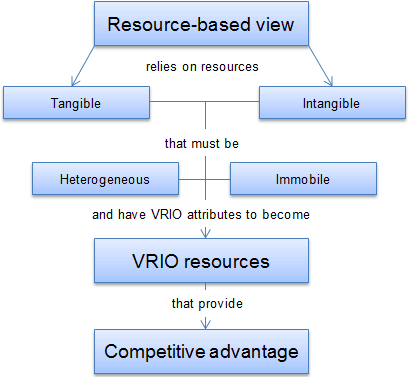
- RBV:
- Tangible: assets, capital, infrastructure
- Intangible: knowledge, routines, capabilities, culture
- Valuable if VRIN (Valuable, Rare, Inimitable, Non-substitutable)
- RDT:
- Anything controlled by others that the firm needs to survive
- Capital, technology, legitimacy, regulation access, data, political support
👉 Same word resource, very different logic.
4. Strategic implications
RBV says:
- Invest in unique capabilities
- Protect know-how
- Build barriers to imitation
- Focus on long-term internal development
RDT says:
- Reduce dependence and uncertainty
- Diversify suppliers and partners
- Form alliances, joint ventures, or mergers
- Influence regulation and power structures
5. View of power
- RBV: Power comes from owning superior resources
- RDT: Power comes from controlling critical dependencies
This is why RDT is popular in:
- Network analysis
- Policy and regulation studies
- Platform ecosystems
- Maritime logistics & port governance 👀 (your territory!)
6. Can they be used together?
Absolutely — and strong papers often do.
Example (maritime / AI context):
- RBV: A shipping firm’s proprietary AI model and data pipeline are strategic assets.
- RDT: The same firm depends on regulators, data providers, satellite firms, and ports — shaping alliances and lobbying behavior.
👉 RBV explains performance, RDT explains structure and behavior.